


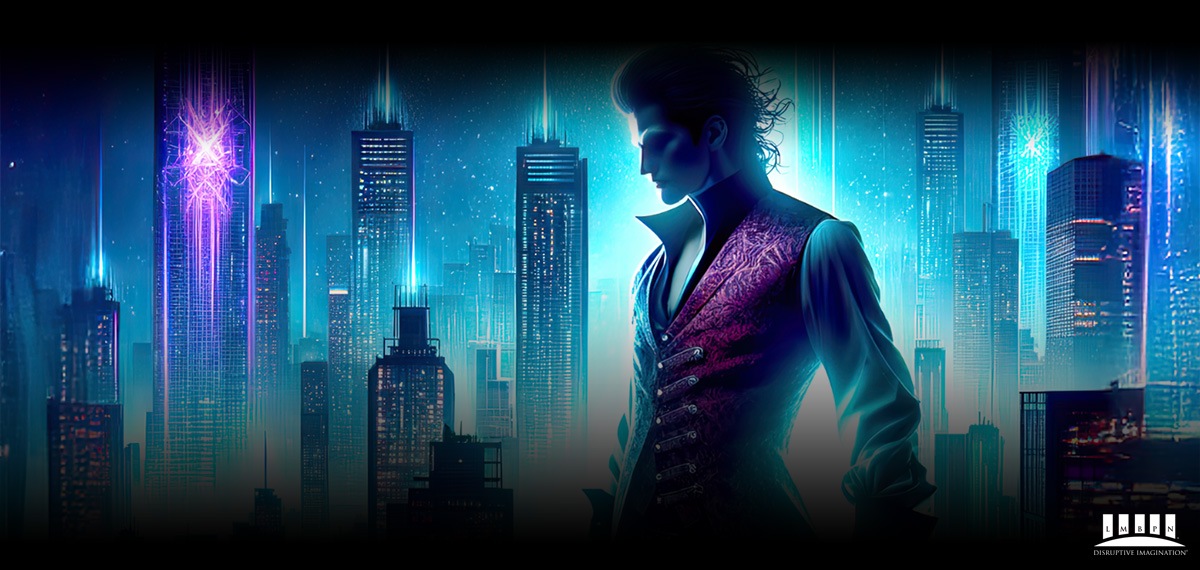
The Accord Book 1: Underground Empire
Burning down his family legacy was suppose to be as simple as a flick of the wrist. Turns out it might be harder than he thought.
Oblivion had an address, and it was in the wettest, grimiest part of Nexus Island.
The rain wasn’t just water. It was a chemical solvent, falling in greasy sheets that smeared the riot of neon across the buckled pavement. It turned the lower district into a bleeding watercolor of kanji and code-script. Steam hissed from street-level grates, smelling of boiled noodles and industrial runoff.
It was the city sighing out its polluted soul.
Perfect.
Isaak von Rothschild pulled the hood of his weather-resistant cloak lower. The high-tech fabric shed the grime-laced water with quiet, hydrophobic efficiency. The world was a mess of sensory input, a constant barrage of data he’d spent a lifetime learning to filter.
Now, he was weaponizing that skill.
A small, unobtrusive light glowed at his temple. The optical feed from his personal recorder painted a subtle telemetry overlay in his vision. Active and documenting. Every drop of rain, every flicker of a dying sign, every desperate face in the crowd was being etched into a digital tombstone.
His own.
Let them see it all. The thought was a cold, hard stone in his gut. Let them watch the gilded family name get dragged through the gutter it was built over.
His encrypted comms device, tucked into his cuff, remained silent. It didn’t need to ping. It was already broadcasting a continuous, high-clearance query. It was a digital ghost whispering through the city’s secure backchannels, a repeating pulse on the GeistNet.
The request was simple. A purveyor, top-tier, for a substance of legendary finality.
The access key was the masterstroke. His own voice, the clipped, aristocratic cadence of a Rothschild, digitized and looped as the signature. It was bait. The kind of bait that drew sharks, not the bottom-feeders who haunted these alleys.
He sidestepped a trio of hustlers peddling black-market stim-patches. Their eyes were hollow, their desperation a palpable stench. He ignored them. They were static in the signal he was hunting. Just more victims of the systems his family profited from.
His mission required a specific kind of artist. A chemist whose work was spoken of in hushed, terrified whispers on the dark-net forums he’d spent weeks scraping. Not some back-alley brew that would just stop his heart. He needed something spectacular.
Something that couldn’t be covered up by his family’s army of fixers and PR drones. Something that would leave a permanent, ugly stain on their polished legacy.
His recorder’s heads-up display, tied to his neural link, chose that moment to be helpful. It flashed an archival image pulled from the Rothschild family servers. A corporate gala. His father, a statue of pride and predatory capitalism. His mother, a portrait of detached elegance, her smile as cold as a cryo-vault.
All of them smiling. Their teeth were as white and sharp as their balance sheets.
Isaak dismissed the image with a twitch of his eye. The file vanished from his vision, but the cold fury didn’t go with it. It was the engine driving him deeper into this neon-drenched hell.
You built an empire on carefully constructed lies and called it a legacy. His jaw was tight. I’ll build my grave on one ugly truth and call it justice.
He turned down a narrower alley, the press of the crowd thinning. The air grew thick with the cloying sweetness of ginger and chili oil from a row of noodle stalls. He passed a vendor hawking synth-protein sticks under a buzzing fluorescent light. The man’s face was a mask of exhaustion.
Isaak moved with a purpose that parted the sea of aimless wanderers. In this part of the city, purpose was either a threat or a target.
He intended to be both.
As he navigated the throng, a small street urchin, no older than ten, stumbled out from behind a stack of overflowing refuse containers. The kid was thin, his clothes little more than rags. A handful of scavenged synth-fruit, bruised and pathetic, scattered across the grimy pavement.
The boy scrambled after them, his movements frantic with the terror of losing a meal.
Without breaking stride, without even looking down, Isaak subtly angled his foot. He kicked a rolling piece of the dull-orange fruit back toward the child’s grasping hand. It was a flicker of an old instinct. A ghost of a man who might have cared.
A man his family had meticulously erased.
Pointless. He crushed the momentary impulse with practiced ease. The kid will be hungry again in an hour. The system is designed that way. He’s just another rounding error in the city’s grand calculation.
He left the boy and the memory behind, focusing again on the mission. The dark-net rumors had been specific. No address. No name. Just a landmark and a symbol.
He found the landmark first. A defunct auto-repair shop with a holographic sign that flickered between “OPEN” and “BIOHAZARD.”
A choice between two kinds of death. How fitting.
Neither seemed particularly inviting. But it was the door next to it that held his attention.
It was unmarked. Forged from some flat, non-reflective alloy that seemed to drink the frantic neon light around it, leaving a patch of absolute blackness in the chaotic alley. And there, etched into the center, was the sigil he was looking for.
A serpent coiled around a chalice.
It was discreet, elegant, and screamed of a professionalism that was utterly out of place in this slum. This was it. The promise of “Exclusive Contraband.”
He stopped. The thrum of a hidden club’s bass vibrated through the soles of his boots. He took a steadying breath, the air thick and tasting of stale synth-ale and chemical rain. This was the precipice. The final gate.
Everything he had done, every risk he had taken, had led him to this single, unassuming door.
The concealed pistol pressed against his side. It was an older model, a solid piece of steel and polymer, a relic from a time before he’d had a security detail to handle such vulgarities. Now, it was just a tool for a negotiation he hoped would be his last. A contingency.
He ran a final mental checklist.
Cred-chip in his pocket, loaded with enough funds to buy his own oblivion ten times over. The fruits of a trust he’d bled dry.
Recorder documenting every second. The data-bomb that would detonate upon his biological cessation, broadcasting his final moments and his family’s dirtiest secrets across every open channel on the GeistNet.
All he needed was the poison.
His hand clenched into a fist at his side, then unclenched. Fear was a luxury he’d discarded years ago. Doubt was a liability. He had stripped himself of both, leaving only the cold, hard certainty of his purpose.
This was not suicide. It was a statement. A final, irrefutable act of defiance against a name he could no longer bear. An identity he was about to weaponize for the last time.
This isn’t an exit. It’s an audit. And the family accounts are about to be zeroed out.
He raised his hand and knocked. Not with the frantic energy of a desperate man, but with the firm, measured rhythm of a client arriving for a scheduled appointment.
For a moment, nothing happened.
The city’s noise seemed to press in on him. The distant wail of sirens, the chatter of a dozen languages, the endless hiss of the rain. It was a chaotic chorus to his final act. He waited, his posture perfectly still.
Then, a soft, pneumatic hiss broke the tension. The lock disengaged. The heavy door swung inward, silent as a tomb.
He stepped across the threshold. The door clicked shut behind him, and the world went silent.
The cacophony of the alley was instantly gone. Swallowed by a profound, sterile quiet that was more unsettling than the noise had been. The air was cool, filtered, and carried the faint, clean scent of antiseptic.
The room wasn’t a grimy drug den. There were no strung-out guards, no piles of illicit goods. It was minimalist, almost clinical. The walls were the same flat, light-absorbing alloy as the door, creating a sense of infinite, black space.
The floor was a polished, seamless surface. His boots made no sound as he took a step forward. His recorder’s indicator light seemed feeble in the oppressive stillness. He’d expected a transaction. A tense, back-alley deal with some twitchy chemist.
This was something else entirely. This was an audience.
The space was empty, save for a single object sitting in the exact center of the room. It was an ornate chair, carved from some dark, polished wood, with high-backed, throne-like proportions that belonged in some long-dead dynasty’s hall.
It looked utterly alien in the sterile, high-tech room.
This is wrong. The thought came, sharp and immediate. A sudden spike of adrenaline cut through his cold resolve. This isn’t a shop. It’s a parlor.
Before he could process the thought, a voice echoed from an unseen source. It was smooth, synthetic, and utterly calm, resonating through the silent room with unnerving clarity.
“The House of Rothschild.”
Isaak froze. His blood ran cold. The synthetic voice hadn’t just used his name. It used the formal title. The one reserved for boardroom takeovers and dynastic threats.
They knew. Not just the name he’d used as bait, but the House itself. The voice wasn’t addressing a client.
It was addressing a peer. Or a specimen.
His entire plan, so meticulously crafted, shattered in an instant. He had walked in believing he was the one setting the terms. A fatal miscalculation. The hunter had just walked into a far more sophisticated trap.
The synthetic voice continued, its tone unchanged, carrying an undercurrent of something that might have been amusement.
“We’ve been expecting you.”
Every muscle in his body screamed to run, to draw the pistol, to do something. But his feet were rooted to the floor. The sheer confidence in that voice paralyzed him. It spoke of a power that didn’t need to brandish weapons.
“Please, have a seat,” the voice purred. “The proprietor will be with you shortly.”
The ornate chair waited. It wasn’t an invitation. It was a summons.
He had come here seeking a simple end, a tool to burn down his past. He had walked onto a stage, yes, but he had catastrophically misunderstood the play.
He wasn’t the one directing this tragedy. He was just another actor, and the script had already been written by a power he couldn’t begin to comprehend.
Will his plan to end it all in a blaze of glory come to a screeching halt or will he be able to pull it off. Find out on September 3rd when Underground Empire: The Accord Book 1 is released. Until then head over to Amazon and preorder it today.